Validated large-eddy simulation method for wind effects in urban areas
Validated large-eddy simulation method for wind effects in urban areas
Abstract
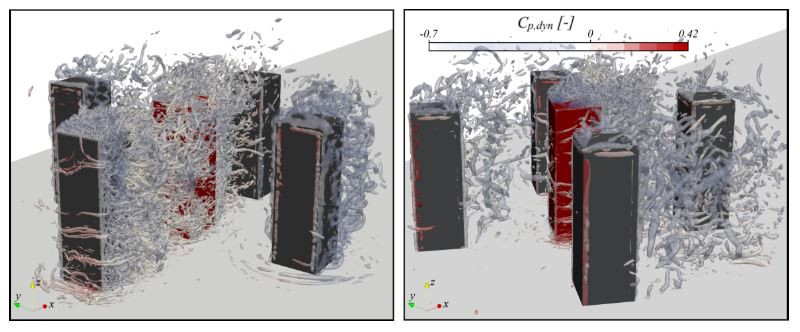
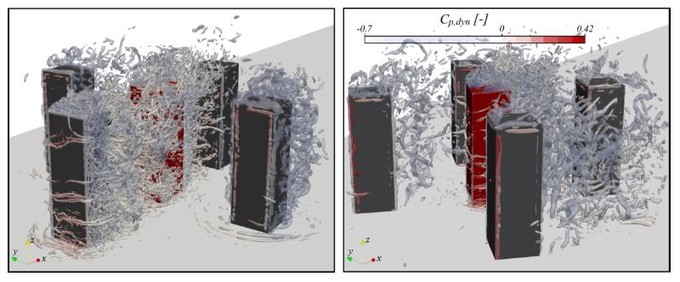
Wind is a powerful natural force that presents both challenges and opportunities in urban environments. The layout of streets and the geometry of buildings shape complex flow patterns. This dissertation explores how these patterns impact urban wind energy harvesting and wind loading on high-rise buildings, offering insights for sustainable urban planning and design. Two approaches can be employed to study wind flow: experimental and numerical. This research focuses on the large-eddy simulation (LES) method, a leading high-precision numerical technique, used to analyse wind flow around either an isolated high-rise building or a cluster of five. Existing wind tunnel tests are employed to validate the numerical simulations. The research examines two wind angles (0°/45°) and two roof types (flat/decked). Findings on urban wind energy reveal that decked roofs offer a higher potential of wind energy than flat ones, as they stabilise flow and create high-speed, low-turbulence zones. In building clusters, interference effects may enhance wind energy potential. Regarding turbine type, vertical-axis wind turbines prove to be optimal. For wind loading, a validation framework for LES-based peak pressure predictions is proposed. Uncertainty analysis from 11-hour experimental data confirms that shorter LES durations (e.g., 25 min) reliably capture peak pressures. Statistical analysis identifies the Gumbel method as more reliable than the peaks-over-threshold approach. Discrepancies between LES and experimental results near upwind roof corners highlight the need for case-specific validation. LES is confirmed as an effective method for simulating urban wind flow. Future work should refine geometry, expand to complex settings, and improve peak pressure estimation. An essential step forward in LES modelling is the development of official guidelines for creating and validating simulations.